Posts Tagged ‘baby nap’

How Many Baby Naps : Sleep Quick Tip

Wednesday, February 3rd, 2010

In the beginning, your newborn sleeps most of the time and you don’t have to worry too much about naps. Your newborn’s sleep schedule and patterns are highly unpredictable, usually, so it’s hard to tell if she will have 5 naps or 8 on any given day. You’ve just given birth (or partnered the birth), so as long as she sorts out the difference between day and night, you probably won’t stress too much about it, unless she isn’t “sleeping like a baby.”

Once the fog lifts, you most likely want more predictability in your day and so you start focusing on getting your baby on a schedule and getting your baby to nap better, especially if your baby won’t nap. Just when you succeed, things change again and you wonder where you went wrong. It’s a good idea to know just when your baby will start to transition to fewer naps, so you know just how long you can enjoy good sleep before he changes on you again.

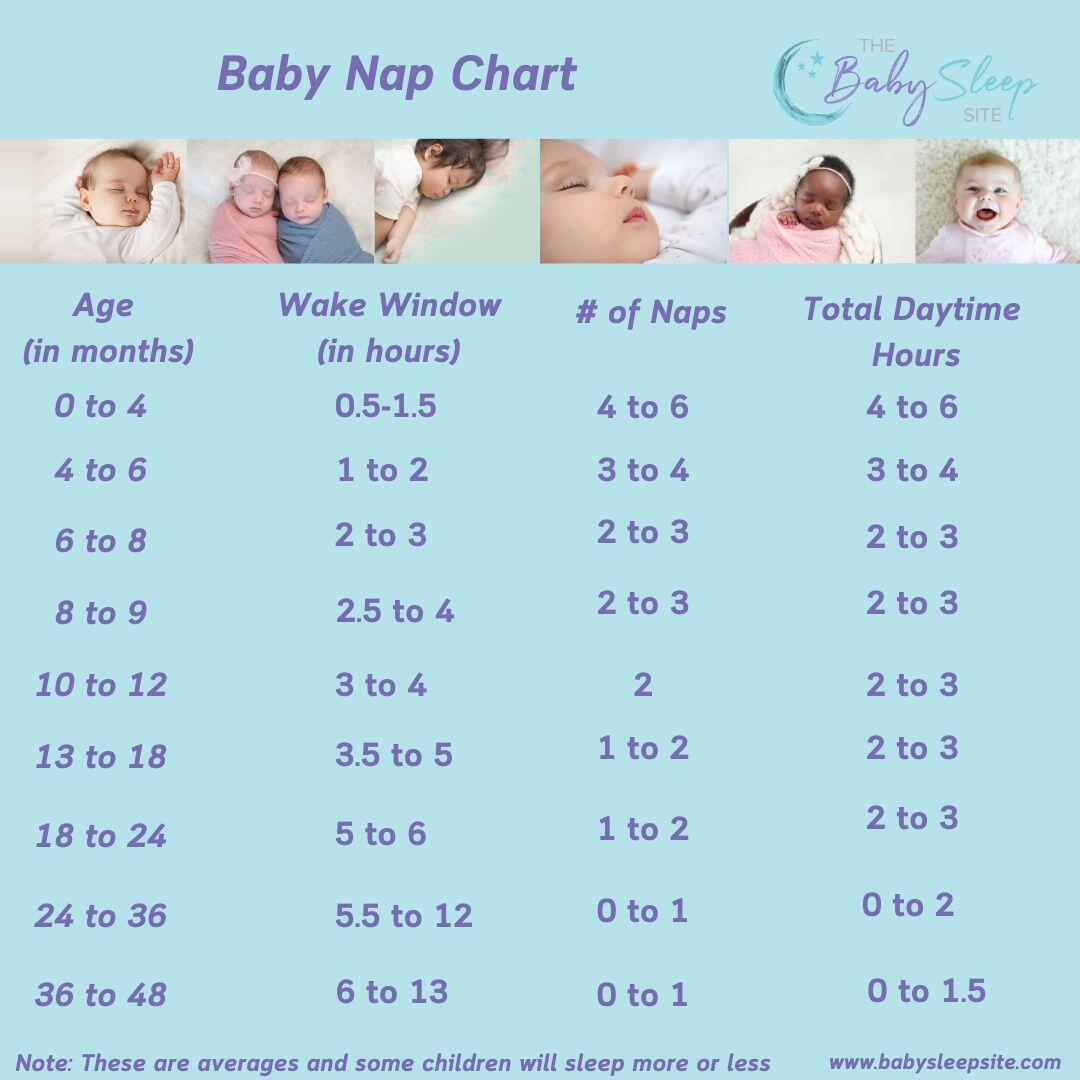
Here are your guidelines to the number of baby naps by age:

From 1-4 months, the number of naps your baby takes will be variable, but will hover around 4-5 naps per day, depending on how long his naps are and how long he can stay up between naps. By 3 or 4 months old, she will lean towards just 4 naps, rather than 5.

From 5-8 months, most babies will have three naps per day (though my son had four until after 7 months) . They will start to resist the fourth nap, no matter how tired they are. There are a few babies who will only have two naps at a very young age, but those naps are usually long.

From 9-15 or 18 months, on average, your baby will nap two times a day. Although many people believe most babies transition to one nap at 12 months, the average age is actually 15 to 18 months.

From 18 months to 4 years, toddlers will nap once a day. The age to transition away from all naps varies a lot, from 2 to 5+ years old.

You may want to view and bookmark our sample baby sleep and feeding schedules by age. And, if you’re looking for ways to get your baby or toddler into a healthy sleeping routine during the day, I encourage you to explore Mastering Naps and Schedules, a comprehensive guide to napping routines, nap transitions, and all the other important “how-tos” of good baby sleep. With over 40 sample sleep schedules and planning worksheets, Mastering Naps and Schedules is a hands-on tool ideal for any parenting style. Or, join our Members Area packed with exclusive content and resources: e-Books, assessments, detailed case studies, expert advice, discounts, peer support, and more! It actually costs less to join than buying products separately! For those looking for a more customized solution for your unique situation with support along the way, please consider one-on-one baby and toddler sleep consultations.

Happy napping!

Bookmark and Share
Category: Naps
Tags: , , , , , , , , ,

When Baby Won’t Nap

Tuesday, October 27th, 2009

Baby Won't NapNaps can be challenging to get from your baby and sometimes it seems like he just won’t nap. Part of the reason your baby won’t nap is because day and night sleep are handled by two different parts of the brain. What your baby knows how to do at night doesn’t necessarily mean he will do the same thing during the day. Depending on how perceptive he is, the sunlight can keep him up or just playing with the smallest piece of lint in the crib. There is a whole lot of fun to miss during the day!

Another reason why your baby won’t nap is because the drive for your baby’s body to sleep at night is strongest. Our internal clocks strongly push us to sleep at night, but during the day, while our babies are sleepy and they do need to nap, the drive to sleep is not strong enough to make it easy for all babies. This is when it gets frustrating. You might try 45 minutes to get a 30 minute nap. And, you might do this 3 times a day!

When your baby won’t nap it’s most frustrating when she’s cranky because of the non-napping or when she refuses to sleep through the night because she’s so overtired come bedtime that she wakes up often at night, unable to settle. Though there are a few babies who appear to do fine without enough napping, naps are a key component of good night sleep, happy babies, and happy parents.

Most of the time, if your baby won’t nap, it can be solved by avoiding some mistakes that many parents make. Today, I begin offering a new free e-Book called 7 Common Napping Mistakes that discusses the 7 most common napping mistakes and what you can do about them. Just like my other free e-Book, 5 Ways to Help Your Child Sleep Through the Night, this e-Book is completely free, with no obligation. To get your free copy, sign up here.

Bookmark and Share
Category: Naps
Tags: , , , , , , , ,

FREE Information Sessions in May

Tuesday, April 14th, 2009

A few weeks ago, I asked you your #1 question about naps and schedules. And, I thank you for all the questions sent to me (keep them coming)! I am now in the process of developing information sessions all about naps and schedules. These information sessions will all be FREE and they start in May! One will include common napping mistakes and another will be a case study on a no-cry napping method of one of my client’s. The last will be a tele-seminar where you will be able to ask live questions.

In order to keep from clogging the blog with posts about the information sessions, I made a new mailing list just for this that you can join to get details about the upcoming naps and schedules information sessions. If you’d like to participate, please click the below link and sign up.

Sign up for FREE information sessions

Thank you for your continued participation in the The Baby Sleep Site™ community! I hope you are finding all the resources you need. Be sure to send e-mail to asknicole [at] picknicksbrain [dot] com with any article ideas if there is anything you have been looking for and haven’t been able to find.

Bookmark and Share
Category: Naps
Tags: , , ,

Your #1 Nap Question

Thursday, March 26th, 2009

NapsI goofed had a technical difficulty, so I apologize for the incomplete post on Tuesday. I didn’t want you to miss adding your question, so here it is again.

I will be writing a series of posts on baby and toddler naps and implementing schedules in the very near future. You might have reviewed some of my sample schedules on the site and have some questions or you have other questions about naps or sleep schedules. Please let me know via e-mail info (at) picknicksbrain (dot) com or post a comment below.

What’s the #1 thing you want to know about naps and sleep schedules?

Bookmark and Share
Category: Naps
Tags: , , , ,

11 Month Old Baby Schedule

Tuesday, October 14th, 2008

10 month scheduleThis article outlines the average 11 month old baby schedule, including feedings, solids, naps and night sleep.

Skip to the schedule


11 month old’s sleep

At this age, most 11 month olds can sleep through the night, without a feeding, and take two naps for a total of 2 to 2 1/2 hours per day plus 11-12 hours at night. A very small percentage transition to one nap as early as 10 months, but not many, so assume 2 naps unless you are certain. My eldest son did transition to one nap one week before his first birthday, so it was in the 11th month that I started seeing his morning nap get later and later. Most babies get very very overtired and sleep can spiral out of control, so I always recommend keeping two naps as long as possible. The average age to transition to one nap is 15-18 months. My younger son seemed to start to transition to one nap around the same time, but went back to two naps within a week or two and continued taking two naps until 15 or 16 months. It makes me think my older son would have gone back to two naps, too, had I given him more time to try. Learn from me. Your 11 month old should be taking 2-3 naps per day for a total of 2-3 hours per day plus 11-12 hours at night. If you’re having trouble with naps, you might be interested in helping your baby nap.

Although many babies can go all night without a single feeding, in my experience, some do better with one feeding after 4 or 5 a.m. and sleep longer than not feed and get an early wake-time. I would need to know your specific situation to make a recommendation, but just recognize that all babies are different. By this age I would not expect more than one feeding, typically, if any at all. I would recommend at least an attempt at night-weaning because it is a chicken and egg problem. It’s hard to encourage more eating during the day when he is eating at night and it’s hard to discourage eating at night when he isn’t eating more during the day.

All babies vary, but here are some rough schedules you can use to make your own for your unique baby. I should warn you that I am in the camp that breast milk or formula should be the primary nutrition for the first year and solids come secondary. Below are the amounts recommended from Super Baby Food, the book I use for reference (as a guide, not as the end-all-be-all because I don’t give my kids nuts before a year or follow other things in the book, but it’s a good reference guide). Another useful reference is Wholesome Baby Food. Although I work full time, I did make most of my baby food (I’d make 1 big batch of something each weekend in 1-2 hours), but even if you don’t, the website is useful as a guide when to introduce what food and other meal ideas.

The amount of food at 11 months is very similar to 10 months, but she may be eating a little more.

Amounts per day:

• At least 3-4 nursing sessions per day or 24-32 ounces formula or combination of both
• No more than 6-8 oz of water or juice (to ensure they drink enough breast milk or formula)
• 2 servings (1 serving = 1-2 Tablespoons dry) baby cereal
• 2 servings grain (1 serving = 1/2 slice bread, 2 crackers, 1/2 cup Cheerios, or 1/2 cup whole grain pasta)
• 2 servings fruit (1 serving = 3-4 Tablespoons)
• 2-3 servings vegetable (1 serving = 3-4 Tablespoons)
• 2-3 servings protein (1 serving = 1-2 Tablespoons)
• 1 serving Dairy (1 serving = 1/2 cup yogurt, 1/3 cup cottage cheese or 1 oz grated cheese)
• You can also offer cooked egg yolk (but no egg whites until 1 year old due to allergans)

The first schedule is what I call a “staggered” approach. My first son did better nursing fully and then having solids a bit in between nursing sessions. He was a little hungry but not famished. He just didn’t do well with stopping nursing mid-way to eat solids.


Sample 11 month old schedule

7:00 – Wake and Breast milk or Formula
9:00 – Breakfast
10:00 or 10:30 – Morning Nap (at least 1 hour)
11:00 – Breast milk or Formula plus snack
1:00 – Lunch
2:00 or 2:30 – Early Afternoon Nap (at least 1 hour)
3:00 – Breast milk or Formula plus snack
5:00 – Dinner
6:15 – Begin bedtime routine
7:00 – Breast milk or Formula and Bedtime (goal to be asleep at this time)

If your baby doesn’t mind a more “consolidated” approach to eating, like my second son, here is another type of schedule:

Schedule 2

7:00 – Wake
7:15 – Breakfast plus Breast milk / Formula feeding
9:15 – Snack
10:00 or 10:30 – Morning Nap (at least 1 hour)
12:00 – Lunch plus Breast milk / Formula feeding
2:00 or 2:30 – Afternoon Nap (at least 1 hour)
3:30 – Snack
5:00 – Dinner plus Breast milk / Formula feeding
6:15 – Begin bedtime routine
7:00 – Small BM/Formula feeding (possibly) and Bedtime (goal to be asleep at this time)

Note: When giving any feedings during your bedtime routine, be careful not to create sleep associations, which we saw become important at 4 months old.

You may also be interested in tracking your baby’s sleep, feedings, medication doses, immunizations, etc. using online software. You can even install on your mobile device for when you’re on the go!

If you’re looking for ways to get your baby or toddler into a healthy sleeping routine during the day, I encourage you to explore Mastering Naps and Schedules, a comprehensive guide to napping routines, nap transitions, and all the other important “how-tos” of good baby sleep. With over 40 sample sleep schedules and planning worksheets, Mastering Naps and Schedules is a hands-on tool ideal for any parenting style. For those persistent nighttime struggles, check out Help Your Child Sleep, a Step-by-Step Guide. Using the same unique approach and practical tools for success, this e-book helps you and your baby sleep through the night. Or, join our Members Area packed with premium content and resources: e-Books, assessments, detailed case studies, peer support, and more. It actually costs less to join than buying products separately! For those looking for a more customized solution for your unique situation with support along the way, please consider one-on-one baby and toddler sleep consultations.

What is your 11-month old’s schedule?

Bookmark and Share
Category: Schedules
Tags: , , , ,

10 Month Old Baby Schedule

Tuesday, September 16th, 2008

10 month scheduleThis article outlines the average 10 month old baby schedule, including feedings, solids, naps and night sleep.

Skip to the schedule


10 month old’s sleep

At this age, most 10 month olds can sleep through the night, without a feeding, and take two naps for a total of 2 to 2 1/2 hours per day plus 11-12 hours at night. A very small percentage transition to one nap as early as 10 months, but not many, so assume 2 naps unless you are certain. Most babies get very very overtired and sleep can spiral out of control, so I always recommend keeping two naps as long as possible as the average age to transition to one nap is 15-18 months. If you’re having trouble with naps, you might be interested in helping your baby nap.

Although many babies can go all night without a single feeding, in my experience, some do better with one feeding after 4 or 5 a.m. and sleep longer than not feed and get an early wake-time. I would need to know your specific situation to make a recommendation, but just recognize that all babies are different. By this age I would not expect more than 1 feeding, typically, if any at all. I would recommend at least an attempt at night-weaning because it is a chicken and egg problem. It’s hard to encourage more eating during the day when he is eating at night and it’s hard to discourage eating at night when he isn’t eating more during the day.

All babies vary, but here are some rough schedules you can use to make your own for your unique baby. I should warn you that I am in the camp that breast milk or formula should be the primary nutrition for the first year and solids come secondary. Below are the amounts recommended from Super Baby Food, the book I use for reference (as a guide, not as the end-all-be-all because I don’t give my kids nuts before a year or follow other things in the book, but it’s a good reference guide). Another useful reference is Wholesome Baby Food. Although I work full time, I did make most of my baby food (I’d make 1 big batch of something each weekend in 1-2 hours), but even if you don’t, the website is useful as a guide when to introduce what food and other meal ideas.

Note: At 10 months, sometimes you notice a sharp increase in appetite (no doubt partially due to activity levels with crawling and possibly cruising), so what’s different about the 9 month schedule is the addition of another snack, some of the serving sizes and the # of servings.

Amounts per day:

• At least 3-4 nursing sessions per day or 24-32 ounces formula or combination of both
• No more than 6-8 oz of water or juice (to ensure they drink enough breast milk or formula)
• 2 servings (1 serving = 1-2 Tablespoons dry) baby cereal
• 2 servings grain (1 serving = 1/2 slice bread, 2 crackers, 1/2 cup Cheerios, or 1/2 cup whole grain pasta)
• 2 servings fruit (1 serving = 3-4 Tablespoons)
• 2-3 servings vegetable (1 serving = 3-4 Tablespoons)
• 2-3 servings protein (1 serving = 1-2 Tablespoons)
• 1 serving Dairy (1 serving = 1/2 cup yogurt, 1/3 cup cottage cheese or 1 oz grated cheese)
• You can also offer cooked egg yolk (but no egg whites until 1 year old due to allergens)

The first schedule is what I call a “staggered” approach. My first son did better nursing fully and then having solids a bit in between nursing sessions. He was a little hungry but not famished. He just didn’t do well with stopping nursing mid-way to eat solids.


Sample 10 month old schedule

7:00 – Wake and Breast milk or Formula
9:00 – Breakfast
10:00 – Morning Nap (at least 1 hour)
11:00 – Breast milk or Formula plus snack
1:00 – Lunch
2:00 – Early Afternoon Nap (at least 1 hour)
3:00 – Breast milk or Formula plus snack
5:00 – Dinner
6:15 – Begin bedtime routine
7:00 – Breast milk or Formula and Bedtime (goal to be asleep at this time)

If your baby doesn’t mind a more “consolidated” approach to eating, like my second son, here is another type of schedule:

Schedule 2

7:00 – Wake
7:15 – Breakfast plus Breast milk / Formula feeding
9:15 – Snack
10:00 – Morning Nap (at least 1 hour)
12:00 – Lunch plus Breast milk / Formula feeding
2:00 – Afternoon Nap (at least 1 hour)
3:30 – Snack
5:00 – Dinner plus Breast milk / Formula feeding
6:15 – Begin bedtime routine
7:00 – Small BM/Formula feeding (possibly) and Bedtime (goal to be asleep at this time)

Note: When giving any feedings during your bedtime routine, be careful not to create sleep associations, which we saw become important at 4 months old.

You may also be interested in tracking your baby’s sleep, feedings, medication doses, immunizations, etc. using online software. You can even install on your mobile device for when you’re on the go!

If you’re looking for ways to get your baby or toddler into a healthy sleeping routine during the day, I encourage you to explore Mastering Naps and Schedules, a comprehensive guide to napping routines, nap transitions, and all the other important “how-tos” of good baby sleep. With over 40 sample sleep schedules and planning worksheets, Mastering Naps and Schedules is a hands-on tool ideal for any parenting style. For those persistent nighttime struggles, check out Help Your Child Sleep, a Step-by-Step Guide. Using the same unique approach and practical tools for success, this e-book helps you and your baby sleep through the night. Or, join our Members Area packed with premium content and resources: e-Books, assessments, detailed case studies, peer support, and more. It actually costs less to join than buying products separately! For those looking for a more customized solution for your unique situation with support along the way, please consider one-on-one baby and toddler sleep consultations.

What is your 10-month old’s schedule?

Bookmark and Share
Category: Schedules
Tags: , , ,

Sleep Quick Tip: Why Does Baby Wake Up Crying?

Tuesday, September 9th, 2008

Obviously, babies wake up crying to eat, because they are wet or dirty (sometimes), or to have their sleep association recreated (such as replacing a pacifier), but this Sleep Quick Tip is to discuss what it possibly means when your baby wakes up crying from a nap or in the morning when they are “done sleeping” (at least you think so).

From my reading, I have not found any definitive reason as to why babies cry when they wake up, but it is normal for them to cry between sleep cycles. With my first-born, if he woke up crying, it 90% of the time meant that he was not done sleeping. He may have awakened in between sleep cycles and had trouble going into the next one. My 2nd son had a much easier time going into the next sleep cycle, most of the time, but he still whimpered a bit, sometimes, between sleep cycles.

This tip is to encourage you not to run in at the slightest whimper because crying between sleep cycles is normal and expected. Babies might not do it every sleep cycle, but they do some. I am not saying you need to allow your baby to cry-it-out, but any amount of crying feels a lot longer than it is. My 2nd son did not have as much of a luxury to be attended to at the slightest whimper because I had my older son to take care of, too. I remember when my 2nd son was around 2 months old, I was fixing my first son lunch and #2 (his name is Nicholas, btw) woke up from his nap. I couldn’t get to him right away, but was walking to his room by the 3 or 4 minute mark and my hand was on the doorknob and he went back to sleep!! I would have disturbed his nap had I been in there any sooner. Of course, at 2 a.m. 3 or 4 minutes feels more like 30, but just keep it in mind and look at the clock.

As I said before, when my eldest son woke up from his nap, crying, it usually meant he was not done sleeping (whether he went back to sleep or not was hit or miss), so if he did wake up crying at least I knew whether to run in there or not. At the very least, I gave him 5 minutes to try to fall back to sleep…that is until I nap trained him. Having said that, I know one woman whose baby, 90% of the time, woke up crying and that’s just how he came out of his sleep cycles, so it didn’t have the same meaning for her.

Does your baby wakes up crying?

Bookmark and Share
Category: Sleep Quick Tips
Tags: , , , , , , , , ,

9 Month Old Baby Schedule

Tuesday, September 2nd, 2008

9 month old scheduleThis article outlines the average 9 month old baby schedule, including feedings, solids, naps and night sleep.

Skip to schedule


9 month old’s sleep

At this age, if you are not lucky enough to have a baby who sleeps through the night, most 9 month olds can sleep all night without a feeding and take two naps. However, some babies, in my experience, do better with one feeding after 4 or 5 a.m. and sleep longer than not feed and get an early wake-time. I would need to know your specific situation to make a recommendation, but just recognize that all babies are different, but by this age I would not expect more than 1 feeding, typically, if any at all. Your 9 month old should be taking 2 naps per day for a total of about 2-3 hours per day plus 11-12 hours at night. If you’re having trouble with naps, you might be interested in helping your baby nap.

All babies vary, but here are some rough schedules you can use to make your own for your unique baby.

I should warn you that I am in the camp that breastmilk or formula should be the primary nutrition for the first year and solids come secondary. Below are the amounts recommended from Super Baby Food, the book I use for reference (as a guide, not as the end-all-be-all because I don’t give my kids nuts before a year or follow other things in the book, but it’s a good reference guide). Another useful reference is Wholesome Baby Food. Although I work full time, I did make most of my baby food (I’d make 1 big batch of something each weekend in 1-2 hours), but even if you don’t, the website is useful as a guide when to introduce what food and other meal ideas.

Amounts per day:

• At least 3-4 nursing sessions per day or 26-32 ounces formula or combination of both
• 2 servings (1 serving = 1-2 Tablespoons dry) baby cereal
• 1-2 servings grain (1 serving = 1/2 slice bread, 2 crackers, 1/2 cup Cheerios, or 1/2 cup whole grain pasta)
• 2 servings (1 serving = 2-4 Tablespoons) fruit
• 2 servings (1 serving = 2-4 Tablespoons) vegetable
• 2-3 servings (1 serving = 1-2 Tablespoons) protein
• 1 serving Dairy (1 serving = 1/2 cup yogurt, 1/3 cup cottage cheese or 1 oz grated cheese)

The first schedule is what I call a “staggered” approach. My first son did better nursing fully and then having solids a bit in between nursing sessions. He was a little hungry but not famished. He just didn’t do well with stopping nursing mid-way to eat solids.


Sample 9 month old schedules

7:00 – Wake and Breast milk or Formula
9:00 – Breakfast
10:00 – Morning Nap (at least 1 hour)
11:00 – Breast milk or Formula
1:00 – Lunch
2:00 – Early Afternoon Nap (at least 1 hour)
3:00 – Breast milk or Formula plus snack
5:00 – Dinner
6:15 – Begin bedtime routine
7:00 – Breastmilk or Formula and Bedtime (goal to be asleep at this time)

If your baby doesn’t mind a more “consolidated” approach to eating, like my second son, here is another type of schedule:

Schedule 2

7:00 – Wake, 1/2 Breast milk / Formula feeding, breakfast and other 1/2 BM / Formula
10:00 – Morning Nap (at least 1 hour)
11:00 – 1/2 BM/Formula, Lunch, and other 1/2 BM/Formula
2:00 – Afternoon Nap (at least 1 hour)
3:00 – BM or Formula Feeding plus snack
5:00 – Dinner and 1/2 BM / Formula feeding
6:15 – Begin bedtime routine
7:00 – Small BM/Formula feeding and Bedtime (goal to be asleep at this time)

Note: When giving any feedings during your bedtime routine, be careful not to create sleep associations.

You may also be interested in tracking your baby’s sleep, feedings, medication doses, immunizations, etc. using online software. You can even use the software on your mobile device for when you’re on the go! Or, you may be interested in more advice about 9 Month olds from Mamasource.

If you’re looking for ways to get your baby or toddler into a healthy sleeping routine during the day, I encourage you to explore Mastering Naps and Schedules, a comprehensive guide to napping routines, nap transitions, and all the other important “how-tos” of good baby sleep. With over 40 sample sleep schedules and planning worksheets, Mastering Naps and Schedules is a hands-on tool ideal for any parenting style. For those persistent nighttime struggles, check out Help Your Child Sleep, a Step-by-Step Guide. Using the same unique approach and practical tools for success, this e-book helps you and your baby sleep through the night. Or, join our Members Area packed with premium content and resources: e-Books, assessments, detailed case studies, peer support, and more. It actually costs less to join than buying products separately! For those looking for a more customized solution for your unique situation with support along the way, please consider one-on-one baby and toddler sleep consultations.

What is your 9-month old’s schedule?

Bookmark and Share
Category: Schedules
Tags: , , , ,

Five Ways to Help Your Baby / Child Sleep Through the Night

Friday, June 27th, 2008

I am pleased to announce that I have a new FREE guide available on my website titled Nick’s Brain, Picked! Five Ways to Help Your Child Sleep Through the Night.

This guide is an e-Book detailing the five primary ways you can help your child sleep all night. To get your free guide, simply fill in your name and e-mail address and push the button (I hate spam as much as you do and will NOT sell your information!).

“At first I thought this was another harsh ‘baby training’ website, but now I see this site is an invaluable resource for parents who want to find their own way to help their child sleep better. 5 Ways to Help Your Child Sleep Through the Night has helped me begin to get better sleep for my child.”
–Elizabeth, France

Bookmark and Share
Category: Announcements
Tags: , , , , , , , , , , ,